2026 CGA Winter Cup Recap
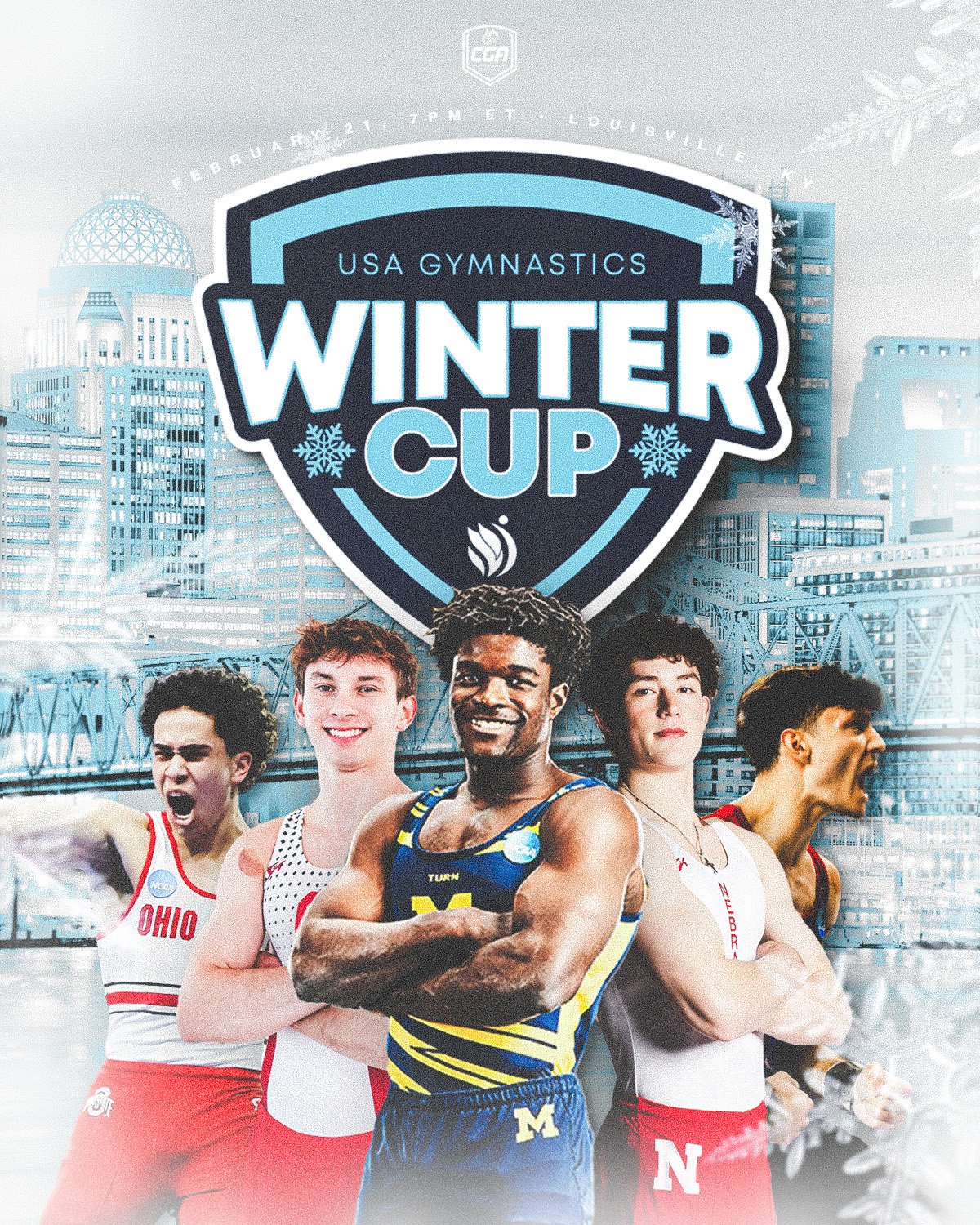
Winter Cup
All Around Recap
There was a large NCAA presence at Winter Cup this year. Past, present, and future NCAA gymnasts were all competing for valuable National Team spots, international assignments, and event titles. The top of the all-around standings was taken by Michigan Wolverine, Frederick Richard. Richard cruised past the rest of the field, hitting six for six difficult routines and scoring an 84.359. A highlight of the competition came on floor exercise, where he scored a 14.355, demonstrating powerful tumbling, including a stuck double-twisting double layout. The parallel bars were also a great event for Richard, where he showed a beautiful Belle release and a stuck double front dismount, scoring a 14.352. Second place in the all-around at his first competition in 18 months was Oklahoma Alumni Yul Moldauer. Moldauer finished his competition with a 79.710, hitting five out of six routines, and started his competition on pommel horse, where he showed stylish flair for a 13.250. Parallel bars were the highlight of Moldauer’s day, where he scored an internationally competitive 14.955, even without his 0.305 in domestic bonus. His giant Makuts and stuck double front half dismount really made a statement for, showing that he's back and he's here to contend. Rounding out the podium is Stanford's David Shamah, who scored a 79.608. Shamah has been competing all around for the Cardinal weekend after weekend, and it has been paying off with his best performance coming at the Winter Cup. Shamah had a stellar performance on the parallel bars, showing difficult front uprise elements and scoring a 14.808.
Event Recap
Floor belonged to the Wolverines at Winter Cup, with Richard’s event title and Charlie Larson’s close finish for second. Larson’s packed routine was good for 14.202, just above 0.150 behind his teammate for the event title. Stanford Alumni Riley Loos rounded out the podium with a 14.150, achieving it without any domestic bonus. The medalists weren’t without close competition though – Stanford’s Jun Iwai matched Richard’s 5.6 difficulty, while Jackson Harrison matched Larson’s 5.5. Ultimately finishing just off the podium in fourth was Nebraska’s Max Odden, with a remarkable 8.900 execution en route to a true 13.700.
Buckeye Parker Thackston’s 15.325 (5.9 / 8.7 +0.725) ran the gambit on pommel horse, with the top difficulty and execution across the field en route to event gold. His closest competition was Preston Ngai (14.308), who has proven himself as the Fighting Illini’s top horse worker while Brandon Dang was away on a National Team assignment. Richard nabbed bronze with a formidable 13.952, ahead of teammate Aaronson Mansberger’s 13.858 in fourth.
Chris Hiser threw down a 14.352 for the rings title, with a 15.000 start, an execution above the 9.0 threshold, a stick bonus, and a domestic difficulty bonus all wrapped into one. Yul Moldauer earned his first of three podium finishes on rings, with the highest difficulty (5.1), but ultimately scoring 14.055 for second. Frederick Richard made himself at home on the podium, securing his second of three event bronze medals with a clean 13.800.
Garrett Schooley finished with a healthy lead even without his domestic bonus, showing two clean vaults at or above a 9.000 execution score. He scored a 14.571 on his first vault, which was a Kasamatsu double full with a large step to the side. Schooley’s second vault was a clean Yurchenko double full, and averaged him a 14.135. Oklahoma’s Sasha Bogonosiuk performed a nicely executed Kasamatsu 1.5 with a small hop for a 13.8, and then a handspring double front for his second vault, which averaged him a 13.575. Lastly, Jackson Harrison averaged a 13.45 for third after performing a beautiful and powerful Yurchenko 2.5 vault, scoring a 13.95, and a Kasamatsu half for their second vault.
Parallel bars was dominated by Yul Moldaur and his reapperance to the national scene. Moldaur performed a varied routine with a 5.4 start value and a 9.15 execution. Moldaur received 0.350 in domestic bonus totaling a 14.955. David Shamah had a spectacular routine, including his front uprise Diamidov, front uprise stutz, and a unique freehip mount. Shamah had a 5.5 start value, a 8.8 execution, and 0.408 in domestic bonus, totaling a 14.808 for second place. Josh Karnes placed third on the parallel bars with his super difficult peach Diamidov mount and a sky high Bhavsar for a 14.408 with 0.408 in domestic bonus.
The field was strong on highbar, with difficult releases and big dismounts, but in the end young Danila Leykin took the highbar crown. If his Pegan, Cassina, and Kolman werent enough to captivate the audience, Leykin also stuck his double twisting double layout for a huge 14.658, with 0.408 in domestic bonus. Crew Bold placed 2nd, with an ambitious 6.0 D score, pulling in an additional 0.513 in domestic bonus. Bold had the highest D-score of the meet, any event, and totaled a 14.263. Third place was taken by Frederick Richard and his 13.85 with no domestic bonus. Richard performed a clean routine with double flipping releases, Tkatchevs, and a double twisting double layout dismount.
Key Features
Navy’s Brian Solomon was the sole representative of the ECAC at the Winter Cup, which is exciting for the Junior. Solomon had many solid performances that landed him 17th in the all-around with a 73.850. Solomon looked fantastic on the floor exercise, where he placed 9th with a 13.500. On the floor, he showed beautiful connection tumbling and a difficult, stuck piked double arabian.
This was the first competition back for two NCAA alumni. University of Oklahoma Alum Yul Moldaur and University of Minnesota Alum Shane Wiskus had their first national competition since the 2024 Olympic Trials. Yul Moldaur made a statement that he was back with his second-place all-around finish and first-place finish on the parallel bars. Moldaur was also able to remake the National Team and was selected to represent Team USA at the 2026 American Cup. Shane Wiskus has been recovering from shoulder surgery that occurred in early 2025. After a few competitions early in 2026, this was Wiskus’s first meet back on the national stage, and he was doing the all-around. Wiskus had a few errors, most notably on the high bar and parallel bars, but strong performances on the floor, pommel horse, rings, and vault show that Wiskus is building and has LA 2028 on his mind.
Army (303.350) @ Simpson (303.200)
It was a tightly contested dual meet in Indianola, with Simpson hosting Army in a battle that came down to the final rotation. Army narrowly edged out the Storm 303.350 to 303.200, taking the team victory by just .150. The meet was defined by momentum swings, counted routines in the four-up, four-count format, and key individual performances that kept the outcome undecided until the final set.Army opened strong on floor exercise, taking the event by just .050. Freshman standout Thomas Morrow earned his first collegiate event win with a 13.700. He opened with a full punch double front, stuck his first pass with authority, and closed the routine with a beautifully stuck double back pike dismount. His amplitude and control from start to finish gave the Black Knights early momentum.On pommel horse, Simpson ran into trouble, falling below the 50 mark as a team and creating a significant deficit. Army captain and senior Maddox Pabellon, coming off a solid performance at the All-Academy Championships, delivered once again. He claimed the event title with a 13.750, showing clean single pommel work, fluid travel elements, and strong extension throughout the routine. Sophomore Jake Prabhakaran continued his consistent stretch of hit routines, reinforcing his reliability in the lineup. Both teams were forced to count a lower score in the four-up, four-count format, which proved costly in the overall team totals. Simpson responded emphatically on still rings, sweeping the top three podium spots. Junior Brian Rollison led the charge with a season-high 13.750. His routine featured controlled strength positions and confident swing elements, signaling that he is peaking at the right time as postseason competition approaches. The Storm’s dominance on rings helped erase much of the earlier pommel horse deficit.Vault proved to be one of the most competitive rotations of the meet. Sophomore Braxton Jones captured yet another vault title this season with a 13.950, continuing to pair high difficulty with consistent landings. Simpson posted greater overall difficulty on the event compared to Army. Army junior Nick Lester finished second with a 13.700, executing a clean 14.40 start value vault that kept the Black Knights within striking distance.Simpson carried that momentum into parallel bars, outscoring Army by nearly two points. Tristan Shorey claimed the event title with a 13.300, a major improvement from last week’s 12.100 and a testament to adjustments made in preparation. Army junior Jacob Brenner placed second, just .250 behind, delivering his strongest routine of the season and positioning himself as a key contributor moving forward. On high bar, Simpson briefly held the top two spots, with teammates Jake Smith and Paul Tiedemann tying for first with 12.900’s. Smith posted his season high, while Tiedemann continued to show consistency in the lineup. However, the Storm were forced to count two low routines, which ultimately shifted the rotation in Army’s favor. Army captured the event by nearly a full point, sealing the narrow team victory. With the result, Simpson moves to 15th nationally, while Army remains ranked 13th.
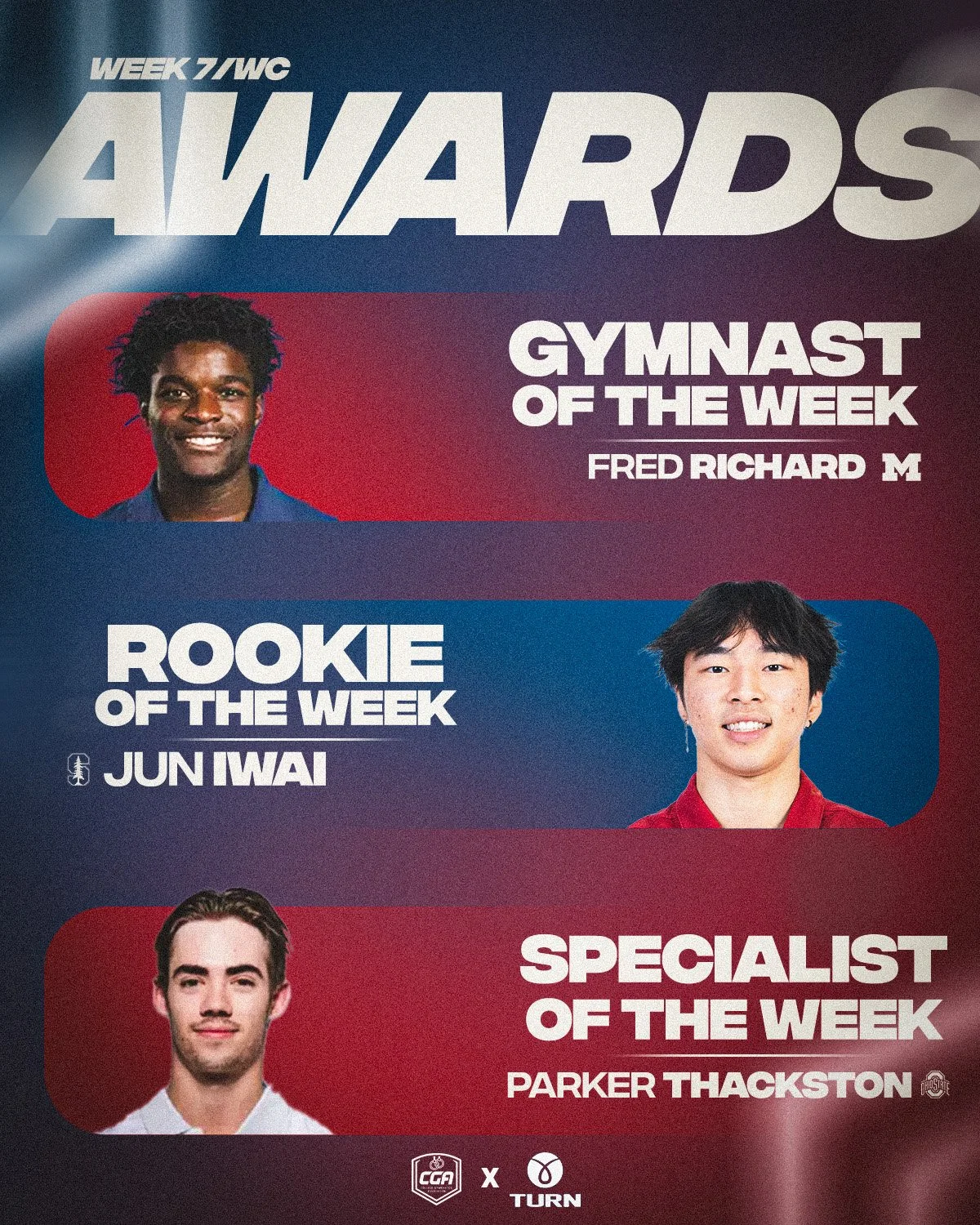
Week 7 / Winter Cup Awards
Week 8 Schedule:
Saturday, February 28 (all times est.)
1:00 pm Greenville, Navy @ Illinois
2:00 pm Army, William & Mary @ Ohio State
6:00 pm @ Air Force (vs Rocky Mountain)
7:00 pm Nebraska @ Oklahoma
7:00 pm California @ Stanford (Stanford International Collegiate)
Sunday, March 1
1 pm Springfield College @ Penn State